Mobile First
Uncovering How Users Really Find Doctors
March–June 2025 | UC San Diego Health
The Challenge
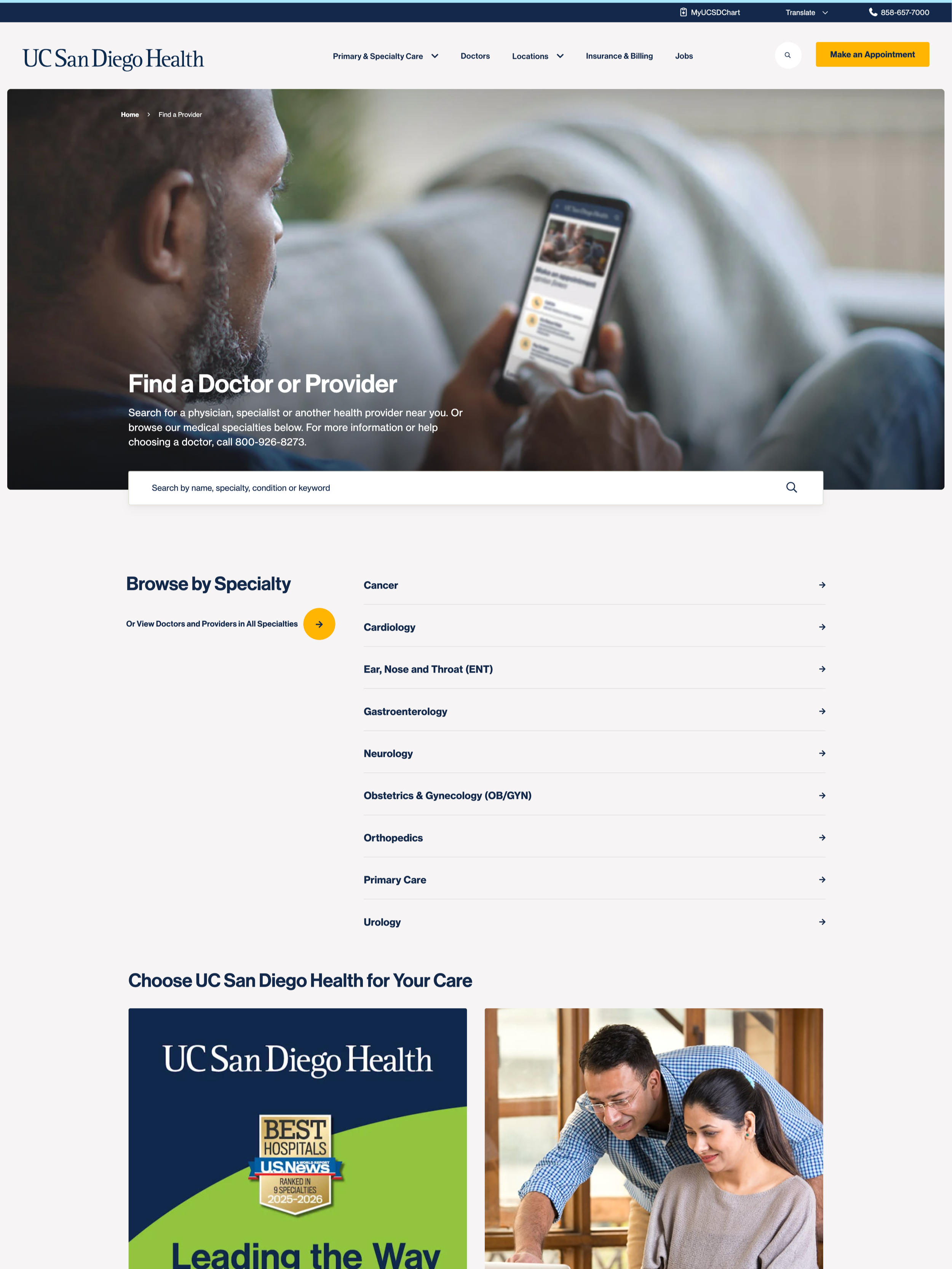
A physician complained that patients couldn't find the "Doctors" section on mobile devices. Leadership wanted to immediately add a prominent link to fix the problem. But was this actually the issue? Before making changes to our high-traffic homepage, we needed evidence. How were mobile users actually navigating to find providers, where was the real friction, and would adding another link solve the underlying problem or just clutter the interface?
Business Objectives
Validate the perceived problem with data before implementing solutions based on anecdotal complaints
Increase mobile engagement with provider content to support appointment booking and consultation requests
Understand device-specific behavior patterns to inform mobile-optimized navigation strategy
Improve conversion rates from homepage to provider pages, particularly on mobile where rates fell below industry standards
Make evidence-based recommendations for homepage real estate allocation and navigation architecture
My Role & Responsibilities
As Lead Researcher, I designed a multi-phase investigation combining baseline analytics analysis, search behavior evaluation, iterative testing of solutions (search optimization and homepage link addition), device-specific conversion tracking, and synthesis of findings into strategic recommendations for mobile navigation architecture.
I collaborated with the Content Director and Digital Experience team to ensure research directly informed implementation decisions while protecting the user experience during testing.
-
Study Type: Multi-Phase Analytics & Optimization Study
Timeline: March–June 2025
Platform: SiteImprove analytics + SiteImprove AnalyticsPhase 1: Baseline Analysis (Before Changes)
Analyzed homepage visitor conversion rates by device (11,951 visitors, 317 conversions)
Documented existing "Doctors" navigation click-through rates: Mobile 1.88% vs. Desktop 2.95%
Identified mobile performance gap: below "good" industry range of 2-5%
Phase 2: Search Behavior Investigation
Analyzed doctor-related search patterns across devices: Desktop conducted 2.7x more doctor searches overall, but only 1.7% on homepage vs. mobile's 4.6% on homepage
Evaluated search term distribution: "primary care" (1,202 searches, 0.4%), "accepting new patients" (810 searches, 0.3%), suggesting search underutilization
Revealed mobile users' higher dependency on homepage search functionality
Phase 3: Search Optimization Test
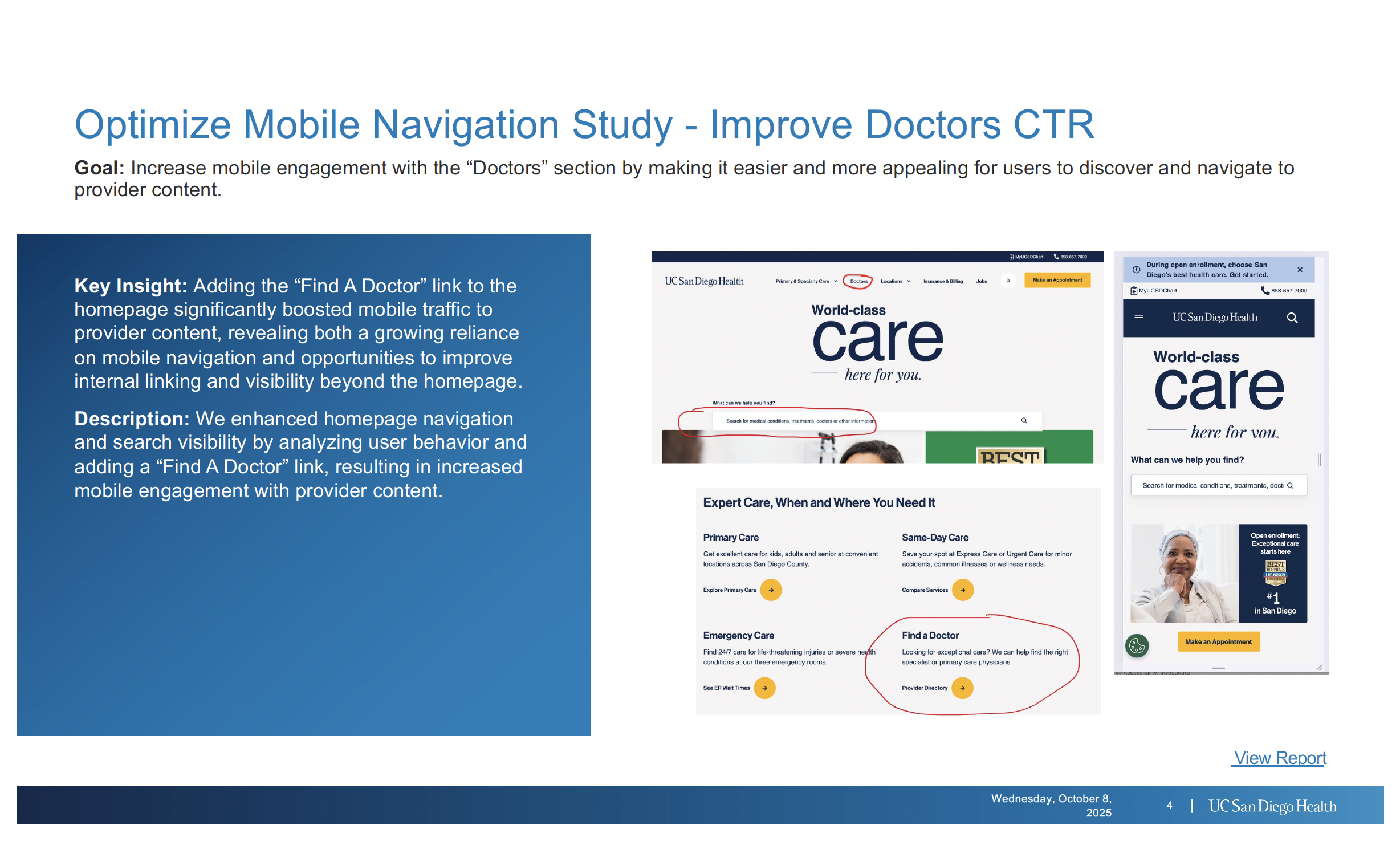
Updated search bar placeholder text to "Search for doctors, medical conditions, treatments or other information"
Made "doctors" explicitly visible in mobile search interface
Result: No significant change in search behavior—search wasn't the primary friction point
Phase 4: Homepage Link Addition & Impact Measurement
Added "Find A Doctor" link to homepage (March 26, 2025)
Tracked traffic changes March→April→May
Monitored event triggers, conversion rates, and traffic source patterns
Compared desktop vs. mobile response to intervention
Key Metrics Tracked:
Conversion rates from homepage to provider pages (by device)
Search query volume and patterns
Direct traffic to provider pages
Internal referrer patterns
Event trigger rates for new homepage link
Mobile vs. desktop engagement differences
-
The Complaint Was Valid, But Not Complete: Mobile conversion from homepage to "Doctors" (1.68%) fell below industry standards while desktop (2.91%) performed well. However, the problem wasn't simply visibility—it revealed fundamental differences in how mobile and desktop users navigate for provider information.
One Simple Change Drove Dramatic Mobile Impact: Adding "Find A Doctor" to the homepage increased mobile traffic to provider pages by 40.8% immediately. Mobile users triggered this new link at 21.4% rate vs. only 8.4% for desktop, revealing mobile users' strong preference for direct, prominent navigation paths.
Mobile Users Navigate Fundamentally Differently: Mobile users relied more heavily on homepage access points (4.6% of their doctor searches happened on homepage vs. 1.7% for desktop), conducted fewer searches overall (2.7x less than desktop), and showed minimal search behavior for finding doctors despite search optimization efforts.
Search Optimization Alone Didn't Move the Needle: Despite updating search placeholder text to prominently feature "doctors," search behavior remained largely unchanged. Mobile users rarely searched for providers using terms like "primary care" (0.4% of searches) or "accepting new patients" (0.3%), indicating they prefer direct navigation over search.
Mobile Share Grew Substantially: Mobile users grew from approximately 20% to over 25% of total provider content traffic post-intervention, indicating both the effectiveness of the change and the growing importance of mobile optimization.
Navigation Gaps Remain: Despite improvements, the homepage accounts for only 19% of mobile visits to provider pages. A significant portion (44.8%) arrives via direct traffic, making it difficult to trace discovery paths and suggesting opportunities to improve internal linking across the site.
-
Immediate Traffic Impact:
40.8% increase in mobile traffic to provider pages in first month post-implementation
16.5% increase in desktop traffic (demonstrating value for both platforms)
Mobile user share of provider traffic increased 25% (up from 20%)
Strategic Insights for Mobile UX:
Validated that mobile users require more prominent, direct navigation paths than desktop users
Demonstrated that search optimization alone cannot solve mobile navigation challenges
Revealed mobile users' reliance on homepage as primary navigation hub (unlike desktop users who explore deeper)
Design Principles Established:
Mobile navigation should prioritize direct access over hierarchical exploration
Homepage real estate for mobile should feature clear, action-oriented links to high-value content
Device-specific optimization matters—one-size-fits-all navigation fails mobile users
Future Research Direction:
Identified need to investigate the 44.8% direct traffic to understand full user journey
Highlighted opportunities to add provider links to other high-traffic internal pages beyond homepage
Established baseline metrics for ongoing mobile conversion monitoring
40.8% increase in mobile traffic to provider pages in first month post-implementation
16.5% increase in desktop traffic (demonstrating value for both platforms)
What I Learned
Data prevented a wrong solution: My initial instinct was to trust the physician's complaint and add the link immediately. Analyzing baseline data first revealed that while mobile conversion was indeed low, search behavior suggested search visibility wasn't the primary issue. Testing search optimization separately confirmed this, preventing us from stopping at a solution that wouldn't have worked.
Device differences run deeper than screen size: I expected mobile users would navigate similarly to desktop but with more friction. Instead, they showed fundamentally different behaviors—more homepage-dependent, less exploratory, preferring direct paths over search. This insight transformed how I think about mobile optimization beyond just responsive design.
Small changes can have outsized mobile impact: A single, prominently placed link increased mobile traffic 40%—far exceeding the 16.5% desktop increase. Mobile users' behavior is more sensitive to friction and more responsive to clear pathways. What seems like a minor addition on desktop can be transformative on mobile.
The absence of behavior is data: Mobile users weren't searching for doctors much at all (very low percentages for doctor-related terms). Initially I saw this as a measurement problem, but it revealed that users simply don't want to search for providers—they want to navigate directly. Sometimes what users don't do tells you more than what they do.
Research phases build on each other strategically: Each phase informed the next: baseline revealed conversion gap, search analysis showed underutilization, search optimization test proved it wasn't the solution, homepage link addition validated the real need. This sequential approach prevented implementing multiple changes simultaneously, which would have made attribution impossible.
Why This Project Matters
Healthcare websites serve users in high-stakes moments—choosing a provider can determine the quality of care someone receives. Mobile users, who often research on-the-go or in moments of immediate need, face unique challenges navigating complex healthcare sites. This research demonstrated that mobile optimization requires more than responsive design—it demands understanding fundamentally different user behaviors and meeting users where they are with direct, frictionless paths to critical content. By validating problems with data before implementing solutions, we avoided wasting effort on changes that wouldn't work while discovering an intervention that dramatically improved the mobile experience and increased access to provider information.
Research Methods: Analytics analysis • Behavioral data analysis • Sequential testing • Device comparison • Search behavior analysis • Conversion optimization
Skills Applied: Quantitative research • Hypothesis testing • Phased experimentation • Mobile UX strategy • Stakeholder communication • Data-driven design • Evidence-based optimization