Flu Flow
Homepage Element Effectiveness
November 2024 | UC San Diego Health
The Challenge
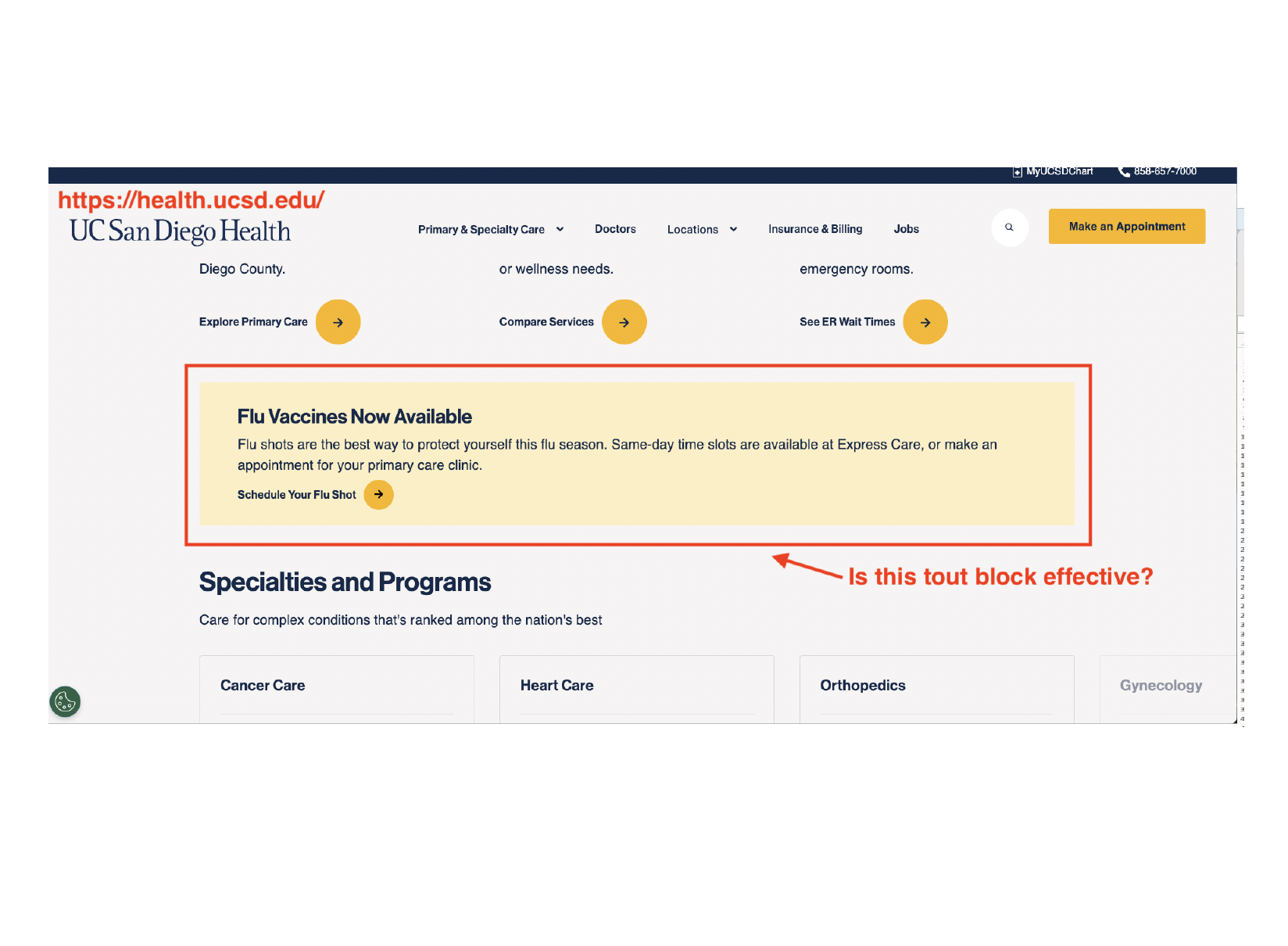
When users seek seasonal health information, should we rely on search functionality or targeted promotional content? Our team needed to test a common assumption: search bars placed higher on the page would naturally outperform content blocks positioned lower. We evaluated whether our flu shot promotional block (tout) was effectively connecting users to vaccination information—or if we should prioritize search placement instead.
Business Objectives
Optimize homepage real estate by determining which element better serves users seeking flu shot information
Understand user navigation preferences between promotional blocks and search functionality
Validate placement strategy for current and future seasonal health campaigns
Guide mobile experience decisions based on device-specific engagement patterns
My Role & Responsibilities
As Lead Researcher, I designed and executed this analytics study, analyzing user behavior data across two 30-day periods, comparing engagement patterns between homepage elements, examining desktop vs. mobile performance, and presenting actionable recommendations to stakeholders.
I collaborated with the Director of Marketing Content Strategy, to align the study with broader content strategy goals.
-
Study Type: Analytics Review
Data Source: Siteimprove behavioral analytics
Time Periods: Two 30-day windows (Sept-Oct 2024)Metrics Collected:
Click-through rates on flu shot tout block
Search volume for flu-related terms
Engagement ratios (tout:search)
Device-specific behavior (desktop vs. mobile)
Initial Hypothesis: Search would outperform the tout block due to higher page placement.
-
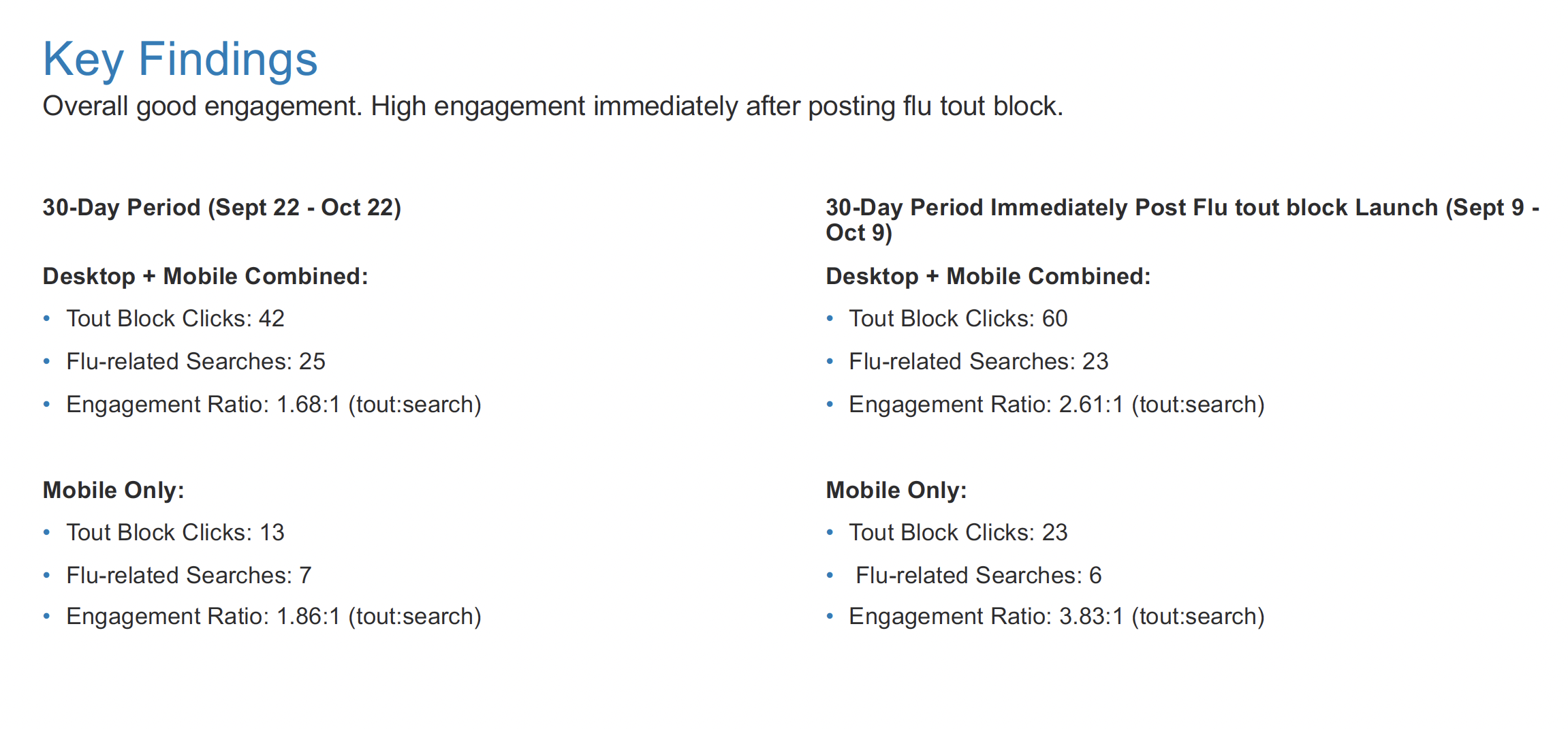
Our hypothesis was wrong. The tout block consistently outperformed search:
Tout block engaged users at nearly 2x the rate of search across all scenarios
Mobile users showed even stronger preference for the tout block (engagement ratio nearly 4:1 post-launch)
30% of tout interactions came from mobile devices
Lower page position did not hinder effectiveness
-
Strategic Validation:
Confirmed current tout block placement is effective and should be maintained
Established that targeted content blocks outperform search for seasonal campaigns
Provided evidence-based justification for continued investment in promotional content
Future Direction:
Maintain current location strategy
Continue optimizing for mobile users based on strong engagement patterns
Consider A/B testing different designs to further improve engagement
Apply evaluation methodology to future seasonal health campaigns
What I Learned
Assumptions need evidence
I initially thought search would perform better due to prominent placement. The data proved otherwise, reinforcing that we should test assumptions rather than accept them as truth.
Context matters more than position
The tout block succeeded because it provided contextual, timely information exactly when users needed it. Relevance and visibility often matter more than page hierarchy.
Mobile users behave differently
The dramatically higher mobile engagement revealed that mobile users favor direct pathways over typing. This insight now influences how I design for mobile-first experiences.
Simple studies drive big decisions
This straightforward analytics analysis directly influenced strategic decisions and established a framework for future evaluations. Research impact isn't always proportional to methodology complexity.
Why This Project Matters
Healthcare websites serve users during moments of stress or uncertainty. This study proved that thoughtful content placement—not just search functionality—reduces friction and helps users accomplish critical health tasks quickly. By establishing a simple, repeatable methodology, this work created a framework that continues informing content strategy decisions across the organization.
Research Methods: Analytics review • Behavioral data analysis • Engagement metrics • Device-specific analysis
Skills Applied: Quantitative analysis • Data interpretation • Hypothesis testing • Stakeholder presentation • Strategic recommendations • Mobile UX insights